Union Push Notifications: How to Reach Your Members Where They Are
Your union emails reach fewer than one member in three. Push notifications change that. Here is how your union can reach its members where they are.
Why Your Emails Are No Longer Enough
Your union emails probably have an open rate between 20 and 30%. That means seven out of ten of your members do not see your communication. Not because they are not interested in what your union says. Because their inbox is already overloaded and your message gets lost in the volume.
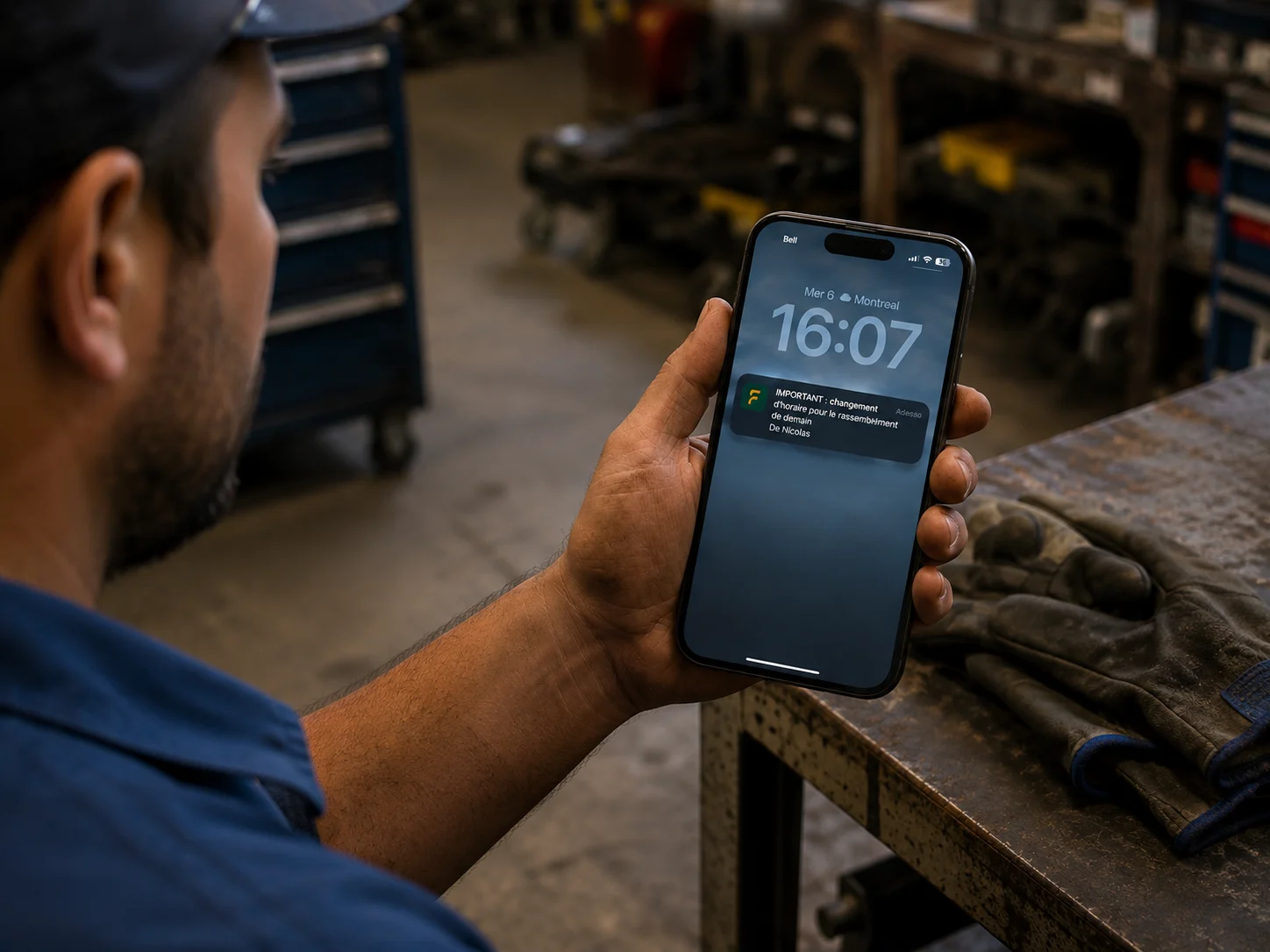
Push notifications work differently. They appear directly on your member's phone screen, regardless of what they are doing at that moment. The read rate for well-used push notifications sits between 60 and 90% according to data on mobile communications in organizational contexts.
The difference is not technical. It is behavioural. Your members check their phone dozens of times a day. They do not check their union email inbox with the same frequency.
How Your Union Can Use Push Notifications
Your Assembly Notices and Reminders
This is the most immediate use case. A notification 7 days out, another 2 days before, a last one on the morning of your assembly. Each notification is short: the date, time, location, one key point from your agenda. Unions that have adopted this practice confirm it: assembly participation increases measurably without changing anything else in the organization.
Your Negotiation Updates
During negotiations, your members want to know what is happening at your table. A short notification after each session, even to signal that discussions are continuing, maintains the connection and prevents rumours from filling the void. It also reduces informal calls and messages to your executive: your members already have the information.
Set up your assembly reminders once in Fortisia: the sequence repeats automatically for every new event.
Book a demoYour Field Alerts During a Strike
This is where push notifications become critical for your union. A directive change on your picket line, an employer decision, an urgent update: the information needs to reach your members in minutes, not hours. No other channel guarantees this reliably. Not your email, not your Facebook group, not Messenger.
Your Important Communications Outside Strikes
An unplanned vote, a working conditions announcement, information that concerns a specific subgroup of your members: some messages deserve to be seen quickly. The push notification is the only channel that guarantees near-immediate visibility without depending on each member's checking habits.
What Your Union Should Avoid
Sending Too Many Notifications
The effectiveness of your push notifications depends directly on their perceived relevance. If you send notifications for everything, including non-urgent information, your members will turn off your app's notifications. Once that happens, it is hard to reverse. The basic rule: your push notification should signal something your member would want to see today, not tomorrow.
Treating Your Notification Like an Email
Your push notification is not an email. It needs to fit in two or three lines: what is happening, what your member needs to know or do. The detail comes in the full message accessible from the notification. Pasting a long text into a notification means it will not be read.
Using Notifications for Non-Urgent Content
Your push notifications are for important and urgent communications. Your news feed or standard messages are better suited for content that does not need to be seen within the hour. Mixing the two dilutes the attention your members give to your notifications, and it eventually stops working.
The Onboarding Question in Your Union
For a push notification to reach your member's phone, that member must have accepted notifications when installing the app. This step needs to be built into your onboarding process: make sure your members enable notifications from the start, by explaining concretely why it will be useful to them.
A member who turns off notifications because they received too many too quickly, or because they did not seem relevant, is hard to re-engage afterward. The first impression of your channel matters as much as any other communication.
How we help
No more important communications getting lost in your members’ overloaded inboxes.
Fortisia sends push notifications directly to every member’s phone, for your communications that cannot wait.
Your members receive directly:
- Your assembly notices and reminders
- Your negotiation updates in real time
- Your urgent alerts during a strike
- Your important announcements as soon as they are published
Result: your urgent communications get through. Your members are informed at the right time, on the right channel.
Frequently Asked Questions
What is the difference between a push notification and an email for your union?
Your email arrives in an inbox your member checks when they decide to. Your push notification appears directly on their phone screen, immediately. The read rate of a well-used push notification is 2 to 4 times higher than that of an email in an organizational context.
How many push notifications should your union send per week?
There is no fixed rule, but the principle is simple: each notification should signal something your member would want to know today. In normal times, 1 to 3 notifications per week is reasonable. During a strike or negotiation, frequency can increase based on your news.
Do your members need to do anything to receive your notifications?
Yes. When installing Fortisia, your member must accept notifications. That is why your onboarding process matters: explaining to your members why enabling notifications will be useful to them increases the activation rate from the start.
Can you target your notifications to specific groups of members only?
Yes. With Fortisia, your notifications can be sent to all your members, to a specific group (by section, role, or site), or to individuals. That lets you send a specific directive to members on one picket site without flooding all your other members.
What do you do if some of your members turn off notifications?
Review the frequency and relevance of your notifications. Most members turn them off because they receive too many or because they did not seem important. Reserving your push notifications for truly urgent communications helps maintain their attention over time.