Union platform and union app: what's the difference?
The two terms are often confused. Yet a union management platform and a union app don't address the same need. Understanding the difference keeps you from investing in the wrong tool or assuming that one alone can solve everything.
In several unions, the thinking starts the same way: "we need a tool." But a tool for what, exactly? Managing grievance files and dues, or reaching members and boosting meeting turnout? Those aren't the same answer. And mixing up the two often leads to the same result: a tool that doesn't meet the needs of your union's members.
What is a union management platform
A union management platform is the back office. It handles member files, grievance tracking, dues, bargaining history and sometimes internal accounting. It's a working tool for the executive and staff, not for the membership as a whole.
It's powerful for structuring sensitive information and keeping a record of everything. But it's generally not designed to be opened every day by someone outside the executive. A member who just wants to know where the next assembly is doesn't need access to a grievance-tracking system. They need a clear notification at the right time.
What is a union app
A union app is the visible side. The one members open on their phone to find out what's happening: official communications, meeting reminders, up-to-date documents and sometimes attendance tracking on a picket line. It's built to be simple and to be used by hundreds or thousands of members, not just the executive.
It doesn't replace administrative file management. That's not its job. Its role is to make sure official information reaches the right person at the right time, without going through four different channels.
Two tools, two different jobs
A common case: a union with a flawless grievance management platform where everything is tracked and documented. But when it's time to call a general assembly, the executive still ends up sending emails, texts and Facebook messages to reach members, and some of them never see the information in time. The platform is doing exactly what it's supposed to do. The problem just isn't where it operates.
The point isn't that one tool is better than the other. It's that they don't meet the same need. A union with an excellent management platform can easily see zero improvement in meeting turnout, because that's not what the tool is meant to do.
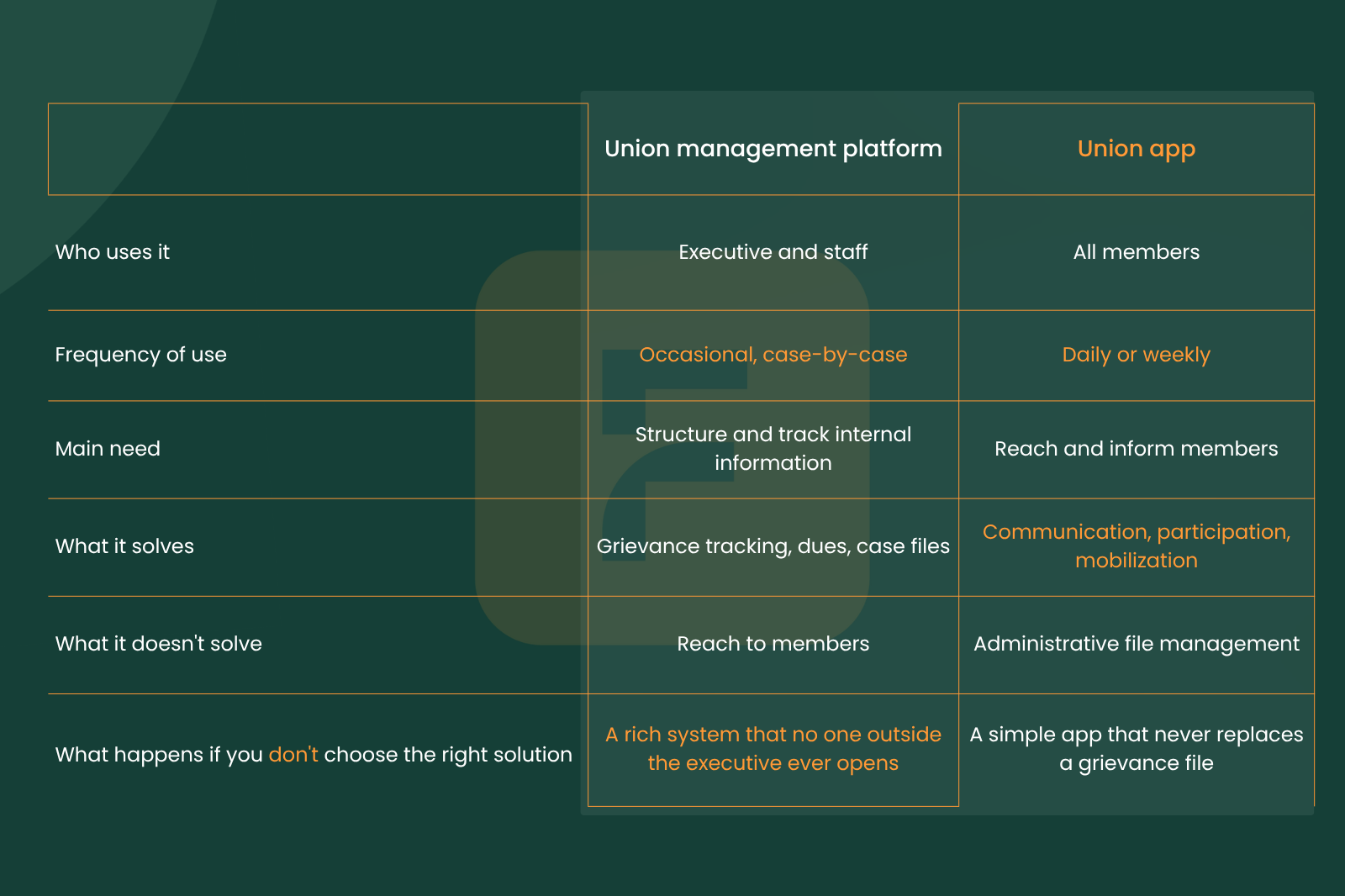
Before choosing a tool, the question to ask is "what problem are we actually trying to solve right now."
A few markers to help decide:
- If the problem is that grievance files and administrative tracking are scattered or poorly documented, the need is on the management platform side. (For example: two staff members each keeping their own Excel tracker, and no one has the full picture.)
- If the problem is that members aren't aware of assemblies, aren't reading communications, or don't know where to find official information, the need is on the union app side. (For example: an assembly notice sent by email that half the members never open.)
- If both problems exist at the same time, it's not about choosing a single tool, but about making sure the two talk to each other, without duplicating data entry.
- In every case, the criterion that matters most is who's actually going to open the tool once it's in place.
It's not a question of available budget. It's a question of knowing where the friction is today. Is it internal management, or reach toward members.
The risk, when this distinction isn't made, is judging a tool by a criterion that was never its own. An executive can invest in an excellent case management platform, then wonder why meeting turnout isn't moving, when that was never what the tool was meant to fix. The problem persists, and the search for a solution goes in the wrong direction.
Fortisia focuses on the member side: centralizing official communications and making them accessible directly on the phone, without replacing the union's internal administrative management.
What is a union management platform?
It's an internal management tool used by the executive and staff to track grievance files, dues and the union's administrative history. It's generally not meant for everyday use by the general membership.
What is a union app?
It's the tool members use directly, most often on their phone, to receive official communications, find out about assembly dates and access up-to-date documents. Its role is to reach members, not to manage internal files.
Can the employer access the app's data?
No. Data from a union app like Fortisia is hosted in Canada and the employer never has access to it. The app belongs to the union, not the employer.
How can a union communicate better with its members?
By centralizing communications in a single channel, rather than spreading them across multiple platforms (email, Facebook, messaging group).